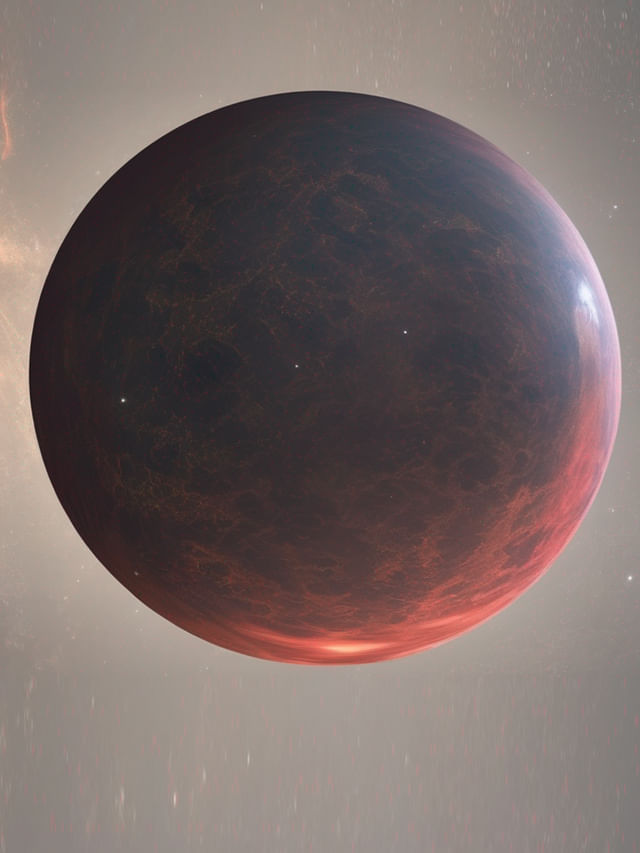
Gliese 412 is a pair of stars that share a common proper motion through space and are thought to form a binary star system. The pair have an angular separation of 31.4″ at a position angle of 126.1°. They are located 15.8 light-years distant from the Sun in the constellation Ursa Major. Both components are relatively dim red dwarf stars.
This system, also known as Lalande 21258, was announced in 1860 as a high apparent proper motion star by Friedrich Wilhelm Argelander as a result of work on the Bonner Durchmusterung (BD). Adalbert Krueger, an assistant to the BD project, was tasked with measuring its parallax. In Krueger's paper reporting the result, he dubbed it Argelander's Third Star.
The two stellar components of this system have a projected separation of about 152 AU, and an estimated orbital semimajor axis of 190 AU. The primary has about 48% of the Sun's mass, while the secondary is only 10%. The primary has a projected rotation velocity at the equator of less than 3 km/s; the secondary has a rotation velocity of 7.7±1.7 km/s.
The primary star was monitored for radial velocity (RV) variations caused by a Jupiter-mass companion in a short-period orbit. It displayed no significant excess of RV variation that could be attributed to a planet. A search of the system using near-infrared speckle interferometry also failed to detect a companion orbiting at distances of 1–10 AU. Nor has a brown dwarf been detected orbiting within this system.
The space velocity components of this system are U = 141, V = –7 and W = 7. They are members of the halo population of the Milky Way galaxy.
X-ray source
The secondary is a flare star that is referred to as WX Ursae Majoris. It is characterized as a UV Ceti-type variable star that displays infrequent increases in luminosity. This star was observed to flare as early as 1939 by the Dutch astronomer Adriaan van Maanen.
Component B (WX Ursae Majoris) has been identified as an X-ray source, while no significant X-ray emission was detected from component A. This system had not been studied in X-rays prior to ROSAT. The Gaia DR2 release gives a parallax of 204.059 ±0.169 mas for B, indicating a distance of around 16 light-years.
References
See also
- List of nearest stars
- X-ray astronomy